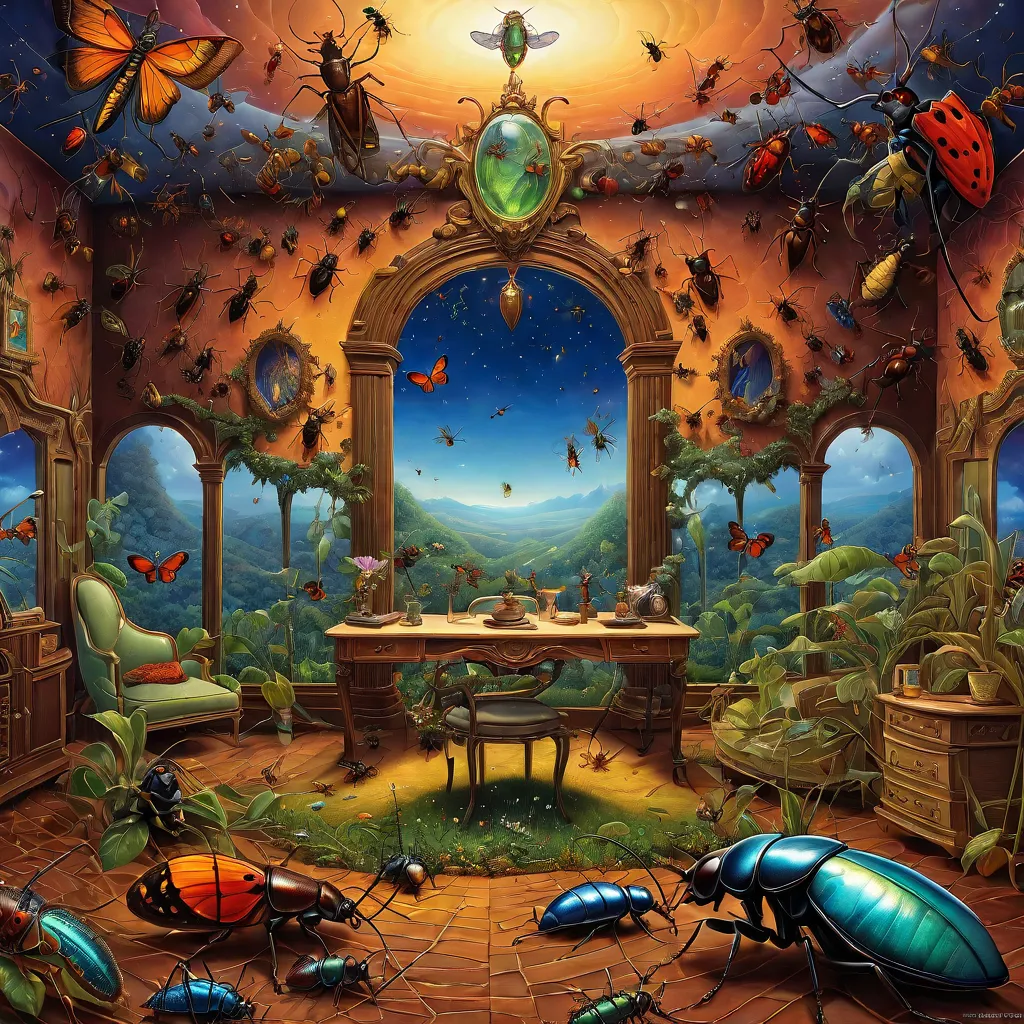
Insect / Bug Infestation
These dreams often begin with a sudden surge of insects—cockroaches, beetles, or ants—crawling over walls, furniture, and the dreamer's skin, filling the space with a rustling, skittering sound. The dreamer feels a visceral dread, a prickling sensation that spreads across the body as the infestation grows uncontrollably.
Psychological Interpretation
You may be confronting a situation that feels overwhelming and out of control, where small problems multiply into a chaotic mess. This dream often surfaces when you are trying to manage mounting responsibilities at work or home, and the feeling of being invaded reflects hidden anxieties about loss of personal boundaries. Recognizing the source of the irritation can help you isolate the specific issues that need attention.
Had this dream?
Are cockroaches and beetles crawling over the walls, or are ants swarming across your skin? Tell us what happened and get a personalized interpretation of your own dream.
Interpret My DreamContemporary Psychological
The brain treats an infestation of insects in a dream as a rapid cascade of threat-related signals. Visual cortex registers the swarm, while the amygdala and insular cortex generate the visceral feelings of disgust and alarm that are typical of real-world encounters with bugs. During sleep, the hippocampus replays recent memories that contain fragments of irritation, contamination, or loss of control, and the default-mode network stitches these fragments into a vivid scenario that tests the organism’s capacity to manage a pervasive, low-level danger. In this way, the dream functions as a simulated rehearsal of coping with a diffuse threat that cannot be eliminated with a single decisive action, mirroring the brain’s need to practice managing chronic stressors rather than acute, isolated events. Emotionally, the infestation motif often reflects a sense that small, persistent problems are encroaching on personal space or identity. The feeling of being covered, bitten, or unable to escape the bugs maps onto waking concerns such as overwhelming workloads, relationship tensions, or health anxieties that feel invasive and hard to contain. Neuroscientific studies show that the same neural circuits that process physical contamination are recruited when people experience social or moral disgust, suggesting that the dream may be encoding a broader judgment that something in the dream life is “dirty” or unacceptable. The intensity of the dream’s emotional tone—whether it is frantic, resigned, or numb—provides clues about the individual’s current capacity for emotional regulation and the degree to which the brain is prioritizing these concerns for consolidation. A practical insight emerging from this perspective is that the dream offers a concrete cue for identifying the specific “infestations” in waking life that are draining mental resources. By keeping a brief journal of moments when the dream occurs and noting any concurrent stressors—such as a looming deadline, a strained conversation, or a health worry—one can map the symbolic bugs onto real problems. Once the link is made, targeted actions such as breaking a large task into smaller, manageable steps, setting clear boundaries, or seeking social support can reduce the feeling of being overwhelmed, allowing the brain’s threat-simulation system to shift from repetitive rehearsal to genuine problem solving.
Jungian / Archetypal
In Jungian terms an infestation of insects is a vivid manifestation of the shadow archetype emerging from the collective unconscious. Insects, with their countless numbers and often hidden, invasive presence, embody the aspects of the psyche that are dismissed, repressed, or regarded as unclean and disturbing. The dream’s repetitive, overwhelming quality signals that these neglected fragments are not merely personal quirks but belong to a deeper, archetypal pattern of the “other” that the conscious mind has failed to integrate. When the dreamer perceives the bugs crawling over the body, infiltrating the home, or multiplying uncontrollably, the image functions as a symbolic alarm that the unconscious is demanding acknowledgment of the parts of the self that have been cast into the darkness of the personal unconscious. The emotional texture that accompanies an insect infestation—disgust, anxiety, helplessness, or even a morbid fascination—reflects the tension between the ego’s desire for order and the chaotic, instinctual currents of the shadow. Such dreams often arise during periods of transition, when the individual is confronting a life change, a suppressed desire, or an unresolved conflict that threatens to erupt. The infestation metaphorically illustrates how the unintegrated material can feel invasive and destabilizing, yet it also offers a pathway toward individuation: by consciously examining the specific qualities of the insects—whether they are tiny and harmless or large and threatening—the dreamer can begin to map the hidden content onto personal themes such as fear of loss of control, feelings of contamination, or the need to attend to neglected responsibilities. A practical insight drawn from this perspective is to treat the dream as an invitation to engage in a deliberate inner dialogue, perhaps by journaling the sensations and emotions that arise when the bugs appear, and then asking what personal “pests”—unacknowledged habits, thoughts, or emotions—are demanding attention. By bringing these shadow elements into conscious awareness, the individual can begin the process of integrating them, reducing the sense of infestation and moving toward a more balanced, individuated self.
Gestalt / Parts of Self
In Gestalt theory a dream is a self-portrait in which every image is a fragment of the dreamer’s own psychic field that has been split off and projected outward. An infestation of insects or bugs therefore signals that the dreamer has disowned a swarm of small, persistent aspects of the self—qualities such as irritability, intrusive thoughts, or unexpressed needs—that feel invasive and hard to control. The insects act as a visual metaphor for these split-off parts, multiplying and spreading across the dream landscape in the same way that the neglected inner material can proliferate when it is not acknowledged. The emotional tone that accompanies the infestation—disgust, anxiety, or a frantic urge to eradicate the pests—reveals the tension between the desire to contain the projected material and the underlying fear that it will overwhelm the conscious personality. From a Gestalt perspective the significance lies in the pattern of avoidance and over-identification. The dreamer may have learned to push uncomfortable impulses into the unconscious, treating them as foreign invaders rather than as integral parts of the whole self. When these disowned elements accumulate, they surface collectively as a swarm, creating a feeling of being bombarded by something that is simultaneously familiar and alien. The recurring nature of such dreams suggests that the individual is repeatedly confronting the same unresolved inner conflict, often linked to situations where they feel powerless or overly scrutinized by others. By recognizing the insects as projections of their own fragmented experiences, the dreamer can begin to retrieve the scattered pieces and reintegrate them, reducing the need for the mind to externalize the distress. A practical insight that emerges from this interpretation is to cultivate a habit of “inner dialogue” when the dream’s emotional residue lingers after waking. Rather than trying to eliminate the feeling of infestation, the individual can ask, “What part of me feels small, persistent, and ignored?” and then give that part a voice, naming its concerns or desires. By bringing the disowned fragment back into conscious awareness and allowing it to be expressed, the dreamer reduces the symbolic need for the mind to project it outward, which can diminish the frequency and intensity of bug-infestation dreams.
Psychodynamic / Freudian
In the psychodynamic view the manifest content of an “insect or bug infestation” dream is the vivid image of crawling, multiplying creatures that seem to overrun the dreamer’s environment. The latent content, however, is the unconscious material that the mind is trying to bring to awareness. The insects often stand in for repressed impulses or anxieties that the dreamer has not been able to acknowledge in waking life; their relentless presence functions as a symbolic outlet for urges that are deemed unacceptable or threatening. The dream may therefore serve a wish-fulfilling function, allowing the unconscious to express a desire for the intrusive material to be expelled, examined, or even controlled, a process that would be too distressing if it occurred directly. The emotional tone that accompanies the infestation—typically disgust, fear, or a sense of helplessness—reflects underlying patterns of anxiety and shame that have been pushed into the unconscious. Defense mechanisms such as projection can be seen when the dreamer attributes their own unwanted feelings to the external “pests,” while displacement may appear when the irritation toward a real-world stressor is redirected onto the insects. Reaction formation may also be at play, with the dreamer outwardly denying any discomfort while the dream’s vividness betrays an inner turmoil. The prevalence of this dream theme suggests that the individual is grappling with a feeling of being overwhelmed by aspects of the self that have been repressed, such as aggressive impulses, sexual desires, or unresolved grief. A practical step for the reader is to treat the dream as a symbolic map rather than a literal warning. By recalling the specific qualities of the insects—size, type, behavior—and noting the emotional response they provoke, the dreamer can begin to trace those qualities back to waking-life situations where similar feelings arise. This reflective exercise can uncover the hidden conflict that the dream is trying to surface, allowing the individual to address the underlying anxiety directly, whether through journaling, therapeutic dialogue, or a conscious effort to acknowledge and integrate the previously disowned impulses.
Personal Meaning
When a person awakens from a dream in which insects swarm, crawl over, or infest a space, the mind is often signaling that something in waking life feels invasive, relentless, and difficult to control. From a personal-meaning perspective the infestation can be read as a metaphor for thoughts, responsibilities, or relationships that have multiplied beyond the dreamer’s capacity to manage, creating a sense of being overwhelmed. The emotional pattern that underlies this imagery is typically a blend of anxiety and disgust, a visceral reaction that mirrors the dreamer’s discomfort with the perceived loss of personal boundaries. To connect the dream to everyday experience, the individual might ask: Which tasks or obligations have multiplied in recent weeks until Do I feel that certain expectations—perhaps from work, family, or self-imposed standards—are crawling into my personal space and crowding out my sense of calm? Are there recurring thoughts or worries that I have tried to sweep aside but that keep resurfacing, much like a persistent swarm? People experience infestation dreams when the brain attempts to organize and externalize internal tension that has become too dense to remain abstract. The mind translates abstract pressure into concrete, sensory-rich symbols—bugs—because they are readily associated with irritation and the need for removal. This translation allows the dreamer to recognize a hidden source of stress that may have been ignored or rationalized during waking hours. A practical insight is to treat the dream as a prompt for systematic decluttering, both physically and mentally. The individual can begin by listing the “bugs” that feel most invasive and then choosing one concrete step to address it, such as setting a boundary with a demanding colleague, scheduling a brief daily mindfulness pause to observe intrusive thoughts, or physically tidying a space that feels chaotic. By taking a small, targeted action, the dreamer can reduce the feeling of infestation and restore a sense of agency over the areas that have been crowding their inner world.
Stress & Emotional Patterns
A dream in which a house, a room, or a body is suddenly overrun by insects or bugs often mirrors a feeling of being swamped by countless small, persistent irritations that you cannot easily push away. The tiny, relentless nature of the creatures can stand for intrusive thoughts, nagging responsibilities, or social demands that feel invasive and out of your control, especially when they multiply faster than you can address them. In many cases the emotional tone of the dream—disgust, panic, or helplessness—parallels the physiological stress response you experience when your mind perceives a threat that is both pervasive and hard to pinpoint, such as chronic work pressure, health anxieties, or relationship turbulence. The infestation may also be a symbolic representation of feeling “infested” by negative self-talk or past traumas that keep resurfacing, suggesting that the dreamer’s mental load is reaching a tipping point where the subconscious is trying to alert them to an overload that is eroding emotional bandwidth. To move from alarm to constructive action, start by pausing to name the specific “bugs” that feel most present in your waking life—whether they are unfinished projects, looming deadlines, or recurring worries about health or performance. Journaling for a few minutes each evening can help you externalize these concerns, turning vague overwhelm into concrete items you can prioritize or delegate. Grounding practices such as a five-minute body scan, deep diaphragmatic breathing, or a brief walk in nature can calm the nervous system and reduce the intensity of the dream’s emotional residue. If the infestation feels tied to interpersonal boundaries, practice assertive communication: clearly articulate limits with colleagues or loved ones and schedule regular “clean-up” periods where you address one small task at a time, preventing the buildup that fuels the dream’s imagery. Finally, consider speaking with a therapist or counselor who can help you reframe intrusive thoughts, develop coping strategies for chronic stress, and explore any underlying anxiety patterns that the bug motif may be surfacing. By turning the symbolic swarm into a manageable checklist and nurturing self-care routines, the dream can become a useful barometer rather than a source of lingering dread.
Related Symbols
Had this dream?
Get a personalized AI interpretation that connects your dream to your specific life circumstances.
Interpret My Dream