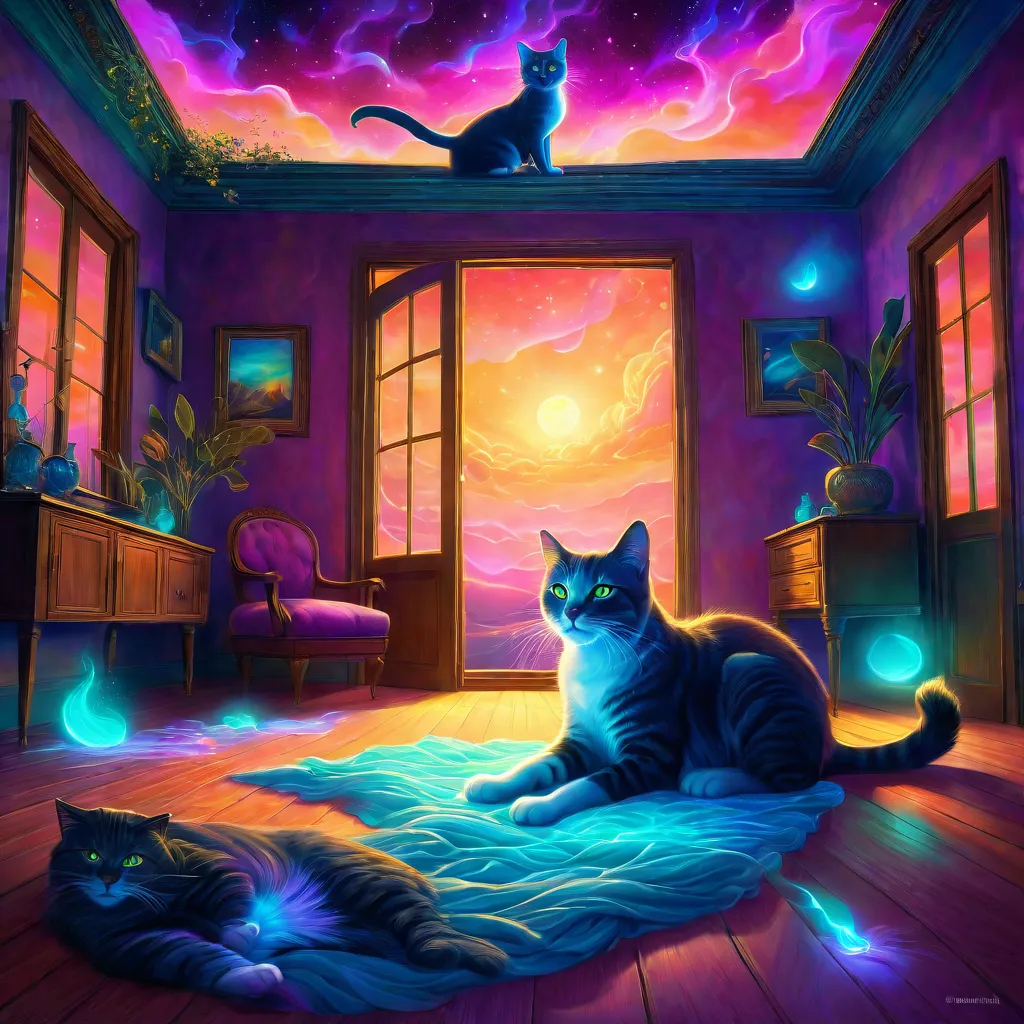
Cats
These dreams often feature a cat slipping silently across a dimly lit room, its fur glistening and its eyes glowing, while the dreamer feels a sudden, electric tingling in the fingertips. The scene feels intimate and slightly uncanny, as if the cat’s presence is both comforting and alerting.
Psychological Interpretation
You may be sensing a need for independence that is being both nurtured and challenged in your waking life. When you encounter a cat in a dream, it often signals that you are navigating a situation where you must balance self-reliance with a desire for connection, especially after recent changes that have left you feeling both curious and cautious.
Had this dream?
Did a silent cat slip through a dim room, or did glowing eyes watch you from the shadows? Tell us what happened and get a personalized interpretation of your own dream.
Interpret My DreamPsychodynamic / Freudian
In a psychodynamic reading, the manifest content of a dream in which a cat appears is the vivid, often playful or mysterious image of the animal itself, while the latent content is the symbolic expression of the dreamer’s unconscious wishes, conflicts, and repressed affect. The cat, with its dual reputation for independence and sensuality, frequently stands for the dreamer’s own ambivalent desires for autonomy and intimacy that have been pushed out of conscious awareness. When the cat is affectionate, the latent wish may be a yearning for nurturing affection that the dreamer feels unable to request in waking life; when the cat is aloof or threatening, it may signal a repressed fear of being abandoned or of losing control, a fear that the ego has defended against by projecting it onto an external figure. The dream thus serves as a form of wish fulfillment, allowing the unconscious to experience, albeit symbolically, the satisfaction of a need for closeness, validation, or mastery that is otherwise denied. The emotional pattern that typically underlies cat dreams involves a tension between the dreamer’s desire for connection and a defensive strategy of repression or displacement. The cat’s behavior can mirror the dreamer’s own coping mechanisms: a cat that slips away may reflect a defensive withdrawal, while a cat that claws may indicate an aggressive impulse that the ego has suppressed and redirected. These defenses protect the conscious self from anxiety but also keep the underlying affective material locked away, prompting the mind to surface it in dream form. Recognizing that the cat is a symbolic stand-in for a personal relational dynamic can help the dreamer become aware of the specific emotional need that has been denied. A practical insight is to notice the cat’s tone and actions in the dream and then ask, “What part of myself am I keeping at a distance, and what feeling am I trying to protect?” By linking the dream’s imagery to a concrete relational situation—such as a neglected friendship or an unexpressed desire for tenderness—the individual can begin to integrate the repressed affect and reduce the reliance on defensive displacement.
Personal Meaning
When a cat appears in a dream, the image often points to the dreamer’s relationship with independence and boundaries. In the framework of attachment theory, the cat can be seen as a symbolic stand-in for a person or situation that offers both comfort and a subtle demand for space. The dreamer might notice whether the cat is sleek and aloof, prowling at the edge of the room, or whether it curls up purring in their lap. These variations invite reflection on how the dreamer negotiates intimacy versus autonomy in daily life. Questions such as “When do I feel the need to retreat into my own world, and when do I seek close connection?” or “What relationships feel like a gentle, self-sufficient presence versus a demanding, clingy one?” help the individual map the cat’s behavior onto real-world patterns of closeness, trust, and self-care. From a psychodynamic perspective, the cat’s nocturnal activity can signal underlying emotional currents of curiosity, hidden desires, or suppressed instincts. The dreamer may have experienced a sudden surge of excitement or anxiety in the dream, perhaps when the cat darts across the floor or when it is brushed aside. Such affective responses often mirror waking moments when the dreamer feels either drawn toward an unexplored aspect of themselves or threatened by a loss of control. The emotional pattern may involve a tension between wanting to explore new possibilities and fearing the unpredictability that such exploration brings. Recognizing this tension can lead to a practical insight: by consciously allowing a small, low-stakes “cat-like” experiment—such as trying a new hobby, setting a modest personal boundary, or simply observing a fleeting thought without judgment—the dreamer can practice integrating the cat’s blend of independence and affection into everyday life, reducing the need for the symbol to surface as a vivid nocturnal reminder.
Contemporary Psychological
Dreams in which cats appear often arise when the brain’s limbic system is sorting through recent encounters with ambiguous social cues. The amygdala flags the animal’s subtle body language as potentially rewarding or threatening, while the hippocampus re-activates memory traces of past interactions with felines—whether a beloved pet, a stray encountered on a walk, or a media image that left a strong impression. In the consolidation phase that occurs during slow-wave sleep, the brain integrates these affective tags with broader narratives stored in the default mode network, producing a scenario in which the cat’s behavior—purring, hissing, or slipping away—mirrors the sleeper’s own unresolved feelings of intimacy, autonomy, or vigilance. From a threat-simulation standpoint, the cat functions as a compact probe of the sleeper’s capacity to negotiate safety and curiosity. When the animal is aloof or aggressive, the dream may amplify the sleeper’s heightened alertness, reflecting a recent episode where personal boundaries were tested. Conversely, a cat that curls up and purrs can signal a period of low-level stress where the brain is rehearsing the reward circuitry associated with calm, affiliative contact. The emotional pattern that underlies these variations is often a blend of low-intensity arousal and nuanced affect, a state that the brain preferentially processes during REM sleep because it allows the integration of affective memory without the interference of external sensory input. A practical takeaway is that the specific demeanor of the cat in the dream can be used as a diagnostic cue for the sleeper’s current emotional equilibrium. If the cat is skittish or distant, it suggests that the individual may be maintaining emotional distance in waking relationships and could benefit from deliberate, low-stakes social engagement to recalibrate the reward-threat balance. If the cat is content and seeks contact, the dream points to an internal readiness for deeper connection, encouraging the person to act on invitations for intimacy rather than postponing them. By paying attention to these subtle cues, the sleeper can align their waking behavior with the brain’s ongoing emotional processing.
Jungian / Archetypal
In Jungian terms a cat that appears in a dream is often read as a manifestation of the instinctual, autonomous side of the psyche that has been relegated to the periphery of conscious awareness. The feline’s lithe movements, nocturnal habits and ability to navigate hidden spaces echo the archetype of the “Shadow” that houses impulses, desires and capacities that the ego has denied or suppressed. When the cat is friendly, purring and seeking affection, it signals that the dreamer is beginning to acknowledge a part of the self that is intuitive, sensual and capable of self-care, qualities that have been dismissed in favor of rational or socially sanctioned behavior. When the cat is aloof, hissing or prowling, it points to a more threatening aspect of the Shadow, warning that the dreamer may be avoiding an inner tension that threatens to erupt if left unintegrated. The emotional pattern that underlies the cat motif is often a tension between independence and dependence. Cats embody a paradoxical blend of autonomy and the need for affection; the dream therefore mirrors a conflict between the desire to assert personal boundaries and the fear of being isolated. This tension can surface during periods of transition, such as a career change, a relational shift, or a stage of life where the individual is called to negotiate new roles. The dream’s vividness reflects the unconscious’s attempt to bring this conflict into awareness, using the cat’s symbolic language to bypass the rational mind and stimulate an affective response that can be felt in the body as a subtle unease or a sudden surge of curiosity. A practical insight that emerges from this interpretation is to treat the cat as a guide for a small, concrete experiment in self-observation. When the dreamer encounters a cat in waking life—or even a representation of a cat in media—they can pause and note the immediate feeling that arises: does the cat evoke comfort, irritation, fascination, or fear? By tracing that feeling back to a current life situation, the dreamer can identify a specific Shadow element that is seeking acknowledgment. Integrating that element—perhaps by allowing a modest indulgence in a pleasure that has been judged “unproductive,” or by setting a boundary that honors personal autonomy—creates a tangible step toward the individuation process that Jung described as the gradual harmonization of conscious and unconscious aspects of the self.
Gestalt / Parts of Self
In Gestalt terms a cat that appears in a dream is read as a fragment of the dreamer’s own personality that has been split off and left to act on its own. The animal’s characteristic independence, stealth, and occasional aloofness are taken to be the qualities of a self-aspect that the dreamer has denied or relegated to the background—perhaps a playful curiosity, a sensuality, or a need for autonomy that feels uncomfortable in waking life. When the cat prowls, scratches, or simply watches from a distance, the dream is projecting that disowned part onto an external figure, allowing the psyche to keep the feeling alive without having to acknowledge it directly. The emotional pattern that underlies the cat motif often involves a tension between attraction and unease. The dreamer may feel drawn to the cat’s graceful movements and soft fur, yet simultaneously experience anxiety about its unpredictable behavior or its tendency to slip away. This ambivalence signals that the split-off self-aspect is both desired and feared: it offers a sense of freedom and sensual pleasure, but it also threatens the stability of the more controlled, socially sanctioned identity. The dream therefore serves as a rehearsal space where the unconscious tests the boundaries of integration, letting the dreamer experience the cat’s presence without the full risk of embracing the underlying trait. A practical insight that emerges from this Gestalt reading is that the dreamer can begin to reclaim the cat’s qualities by treating the animal not as an external entity but as a symbolic mirror of an inner capacity. When the cat appears, the dreamer might pause and ask what feeling or impulse the cat seems to embody at that moment—whether it is a desire for playful exploration, a need for personal space, or a latent sensuality. By consciously acknowledging the feeling as part of the self and allowing it a brief, safe expression in waking life, the dreamer starts the process of reintegrating the disowned fragment, reducing the need for the dream to project it outward. This small step toward ownership can lessen the recurring intensity of cat dreams and promote a more cohesive sense of self.
Stress & Emotional Patterns
Dreams in which cats appear often surface when the mind is trying to sort out boundaries that feel fuzzy or threatened. A cat’s sudden, independent nature can mirror a feeling that something in waking life is slipping out of control, while the animal’s reputation for both affection and aloofness may reflect a conflict between wanting closeness and fearing vulnerability. When the cat is calm and purring, it can be a cue that the dreamer is yearning for a safe, self-soothing space amid a period of heightened anxiety; when the cat is hissing, scratching, or prowling, it may signal that the dreamer perceives a looming pressure—perhaps a demanding workload, a relationship tension, or an internal critic—that feels unpredictable and hard to contain. The emotional tone of the cat’s behavior often aligns with the dreamer’s current stress load: a frantic chase after a cat can echo a sense of being chased by responsibilities, while a cat perched high and watching from a distance can embody a feeling of detachment or helplessness in the face of overwhelming demands. To work with this imagery, the dreamer can first acknowledge the specific feelings the cat evokes and then translate them into concrete self-care actions. If the cat feels threatening, a practical step is to identify one area of life where boundaries have blurred—such as taking on too many tasks or saying “yes” to others—and practice a small, assertive boundary, like delegating a task or scheduling a brief “no” period each day. If the cat is soothing, the dreamer might cultivate that sense of inner calm by setting aside a regular ritual of gentle, sensory-rich activity—like a short walk, a warm cup of tea, or a brief meditation—allowing the body to register safety and counteract the physiological arousal that stress creates. Journaling the dream immediately upon waking, noting the cat’s posture, color, and the dreamer’s emotional reaction, can also help map recurring patterns and reveal whether the cat is acting as a warning signal or a reminder to nurture one’s own autonomy and need for restful, grounded moments.
Related Symbols
Had this dream?
Get a personalized AI interpretation that connects your dream to your specific life circumstances.
Interpret My Dream