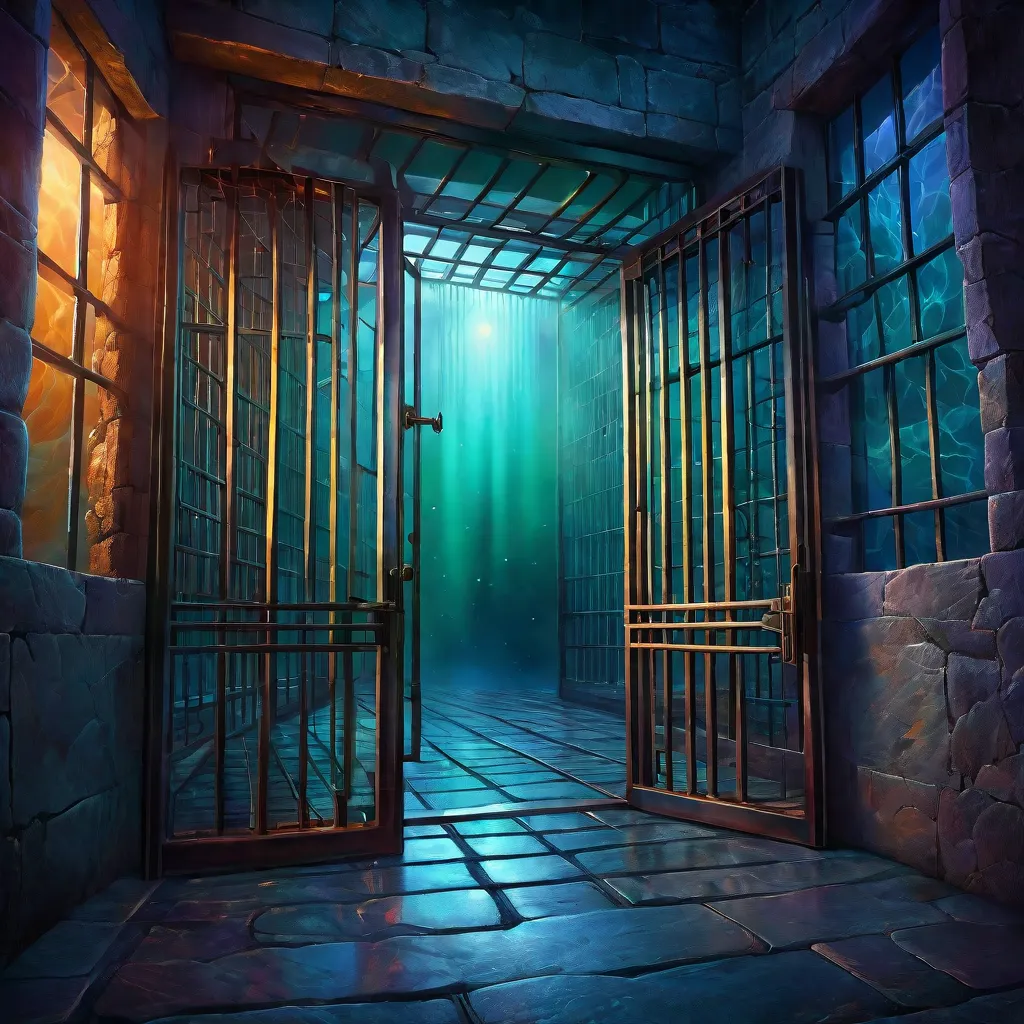
Being in Prison / Jail
These dreams often place the dreamer behind bars, hearing the clang of metal doors and feeling the stale air of a cell. The atmosphere feels claustrophobic, with a constant echo of footsteps and a lingering sense of helplessness.
Psychological Interpretation
When you wake from this dream, it often points to feelings of confinement or loss of autonomy in your waking life. It may arise when you are stuck in a demanding job, a restrictive relationship, or a legal or financial situation that feels out of your control. Recognizing the metaphorical bars can help you identify where you need to assert boundaries or seek freedom.
Had this dream?
Are you behind bars in a stale cell—or walking corridors as metal doors clang and footsteps echo? Tell us what happened and get a personalized interpretation of your own dream.
Interpret My DreamPersonal Meaning
When the mind constructs the image of a cell block, a barred window, or a uniformed guard, it is often echoing a feeling of confinement that the dreamer is experiencing in waking life. From a personal-meaning perspective the prison symbol can point to a situation in which the individual perceives a loss of agency—perhaps a job that feels restrictive, a relationship that demands compliance, or an internal rule set that feels imposed by a parent, a culture, or a self-critical inner voice. The dream invites the sleeper to ask, “What part of my day-to-day routine feels like I am serving a sentence?” and “Which expectations, either external or internal, feel like they are holding me hostage?” By naming the specific arena—be it a demanding project, a health regimen that feels punitive, or a social role that requires constant performance—the dreamer can begin to map the metaphorical bars onto concrete circumstances. Psychologically, the prison dream taps into the anxiety of being trapped by circumstances that appear immutable, and it often surfaces when the dreamer is wrestling with a conflict between desire and duty. The emotional pattern behind it typically includes a mix of frustration, helplessness, and a lingering sense of guilt, suggesting that the individual may be suppressing an impulse that feels unsafe to act upon. The mind creates the jail as a dramatized stage where the tension between autonomy and obligation can be examined without the risk of real-world consequences. People experience this dream when they have internalized a narrative of “must-do” that eclipses their personal values, or when they have been punished—real or imagined—for deviating from a prescribed path. Recognizing that the prison walls are constructed from thoughts and expectations rather than physical bricks can be liberating; the practical insight is to experiment with small acts of rebellion in waking life—such as setting a boundary, taking a brief break from a demanding routine, or voicing a suppressed opinion—to test whether the perceived confinement loosens, thereby gradually reshaping the dream’s narrative from one of incarceration to one of negotiated freedom.
Contemporary Psychological
Dreams of being locked behind bars often arise when the brain is trying to integrate memories of social exclusion, criticism, or self-imposed discipline. Neuroimaging studies of REM sleep show that the amygdala and ventromedial prefrontal cortex reactivate while the hippocampus replays recent interpersonal episodes, producing a vivid simulation of threat that feels both personal and abstract. In this state the mind can amplify feelings of powerlessness, shame, or guilt into a concrete setting—prison—because the environment supplies a clear, culturally shared symbol of confinement. The emotional pattern that underlies the dream typically involves a mismatch between the dreamer’s desire for autonomy and an internal narrative that they have violated a rule, failed a standard, or are being judged by an external authority. The brain’s threat-simulation circuitry therefore constructs a scenario in which the dreamer is literally restrained, allowing the emotional charge of the underlying conflict to be processed in a safe, virtual space. People experience prison-type dreams most often when waking life contains unresolved pressures to conform, chronic stress about performance, or a sense that one’s choices are being monitored. The consolidation of such stressors during sleep can manifest as a metaphorical cage, especially if the dreamer has recently faced disciplinary action, legal worries, or intense self-criticism. The dream’s persistence signals that the neural networks encoding these concerns have not been fully integrated, leaving the emotional memory fragmented and prone to re-emergence. A practical step is to map the feeling of confinement onto a concrete domain—such as a demanding job, a strained relationship, or a personal habit—and then experiment with small, concrete actions that restore agency, like setting a clear boundary, scheduling a brief period of autonomy, or writing a brief self-compassion note before sleep. By deliberately addressing the source of the perceived restriction, the brain can re-encode the memory with a more balanced emotional tone, reducing the likelihood that the prison scenario will dominate future dream content.
Jungian / Archetypal
In Jungian terms a dream of being confined in a prison or jail is often an image of the Self confronting the Shadow, the part of the psyche that has been denied or repressed. The bars and walls symbolize the inner limits that the conscious ego has erected to keep unacceptable impulses, forgotten memories, or unintegrated aspects of the personality out of awareness. When the dreamer finds themselves locked up, the unconscious is signaling that these disowned elements have accumulated enough psychic energy to demand acknowledgment, and the dream’s setting becomes a dramatized arena for the individuation process. The emotional tone—typically fear, frustration, or a lingering sense of injustice—reflects the tension between the ego’s desire for control and the Shadow’s insistence on being heard. The psychological significance of this motif lies in its capacity to reveal how the dreamer’s current life circumstances may be mirroring an inner imprisonment. A person who feels trapped in a job, a relationship, or a set of self-imposed expectations may project those external constraints onto the symbolic prison, while the underlying emotional pattern often involves a reluctance to confront aspects of the self that feel shameful or dangerous. The dream therefore serves as a mirror of the inner conflict between the need for safety and the call toward authenticity; the prison is not merely a place of punishment but a container in which the psyche is urging the ego to negotiate with the Shadow and to begin the work of integration. A practical insight that emerges from this interpretation is that the dreamer can use the image of the prison as a prompt for conscious dialogue with the parts of themselves that feel confined. By identifying specific feelings of restriction in waking life and allowing oneself to explore the hidden motives or fears behind them—perhaps through journaling, active imagination, or therapy—the individual can gradually dissolve the symbolic bars. This process transforms the dream from a warning of stagnation into a catalyst for the next stage of individuation, where the self moves from a state of enforced isolation toward a more expansive, integrated wholeness.
Gestalt / Parts of Self
In Gestalt terms the image of a prison or jail in a dream is understood as a vivid projection of a part of the dreamer that has been split off and left to “serve a sentence” in the unconscious. The bars, the guards, the locked doors are not symbols of external punishment but concrete manifestations of a self-segment that the dreamer has denied, suppressed, or failed to acknowledge. When the dreamer stands inside the cell, the feeling of confinement is the body’s way of signaling that a particular feeling, desire, or belief is being held captive by the conscious mind’s attempt to keep it out of awareness. The dream therefore becomes a stage where the disowned part is demanding contact, asking the dreamer to notice its presence, its needs, and its perspective, rather than continuing to be hidden behind the metaphorical walls of repression. The emotional pattern that typically accompanies this dream is a mixture of anxiety, shame, and a lingering sense of injustice that originates from the internal conflict between the part that wants to act and the part that insists on restraint. People experience the prison dream when they have been living in a situation where a core aspect of their identity—such as a creative impulse, a suppressed anger, or an unexpressed longing—has been repeatedly denied, leading the psyche to externalize the feeling of being locked up. The practical insight offered by this Gestalt reading is to treat the prison not as a warning about external circumstances but as an invitation to engage in a dialogue with the incarcerated part: to ask what it needs to be released, to allow it to speak in the waking life, and to negotiate a new, more integrated relationship where the walls are lowered through conscious acknowledgment rather than continued avoidance. By doing so, the dreamer can transform the feeling of confinement into a step toward wholeness.
Psychodynamic / Freudian
In psychodynamic terms the manifest content of a dream in which the sleeper finds themselves behind bars is the literal scenario of confinement, surveillance, and loss of freedom. The latent content, however, is the symbolic expression of an inner conflict that the conscious mind has not fully acknowledged. The prison often stands for a psychic prison constructed by repressed impulses, unresolved guilt, or internalized authority that the ego cannot easily integrate. The dream’s setting allows the unconscious to dramatize a wish for containment: by externalizing the feeling of being trapped, the mind can temporarily satisfy the urge to keep threatening thoughts at a distance, thereby preserving the ego’s sense of order. Defense mechanisms such as repression and reaction formation are at work; the sleeper may have pushed unacceptable wishes—perhaps aggressive or sexual impulses—into the unconscious, and the prison imagery serves as a safe container in which those wishes can be imagined without confronting their moral implications directly. The emotional pattern that typically accompanies this dream includes anxiety, shame, and a pervasive sense of helplessness, all of which point to an internalized punitive voice that mirrors an early caregiver’s strict standards. When the dreamer wakes, the lingering feeling of confinement often reflects a current life situation—such as a demanding job, a restrictive relationship, or a self-imposed moral code—that feels as oppressive as a literal cell. The psychodynamic interpretation suggests that the dream is a signal that the ego is struggling to negotiate between the id’s forbidden desires and the superego’s harsh judgments, and that the unconscious is attempting to negotiate a compromise through symbolic imprisonment. A practical insight for the reader is to examine areas of life where they feel overly constrained and to ask whether those constraints are imposed by external circumstances or by an internalized critic; recognizing the source can open a pathway to gradually loosening the self-imposed bars and allowing repressed material to be processed in a more conscious, therapeutic manner.
Stress & Emotional Patterns
Dreams of being locked up, handcuffed, or wandering the corridors of a prison often surface when the mind is trying to make sense of a feeling of confinement in waking life. The imagery of bars and guards is a symbolic shorthand for situations where the dreamer perceives a loss of agency—whether it is a demanding job that leaves no room for personal time, a relationship that feels controlling, or an internal critic that relentlessly enforces perfection. The emotional tone of the dream—panic, shame, resignation, or even a strange sense of safety—can reveal which aspect of stress is most dominant. A frantic escape attempt usually points to acute anxiety and a sense of being overwhelmed by immediate pressures, while a resigned acceptance of the sentence may indicate chronic burnout, where the dreamer has internalized the belief that they cannot change their circumstances. In either case, the prison metaphor signals that the dreamer’s stress response is stuck in a “locked-in” mode, where the nervous system remains on high alert and the sense of personal freedom is eroded. To move beyond the nightmare, it helps to first name the specific “bars” that feel most oppressive and then test their reality. Keeping a brief journal of moments during the day when a sense of restriction arises—such as a meeting that runs overtime, a family expectation that feels non-negotiable, or a self-imposed deadline—creates a concrete map of triggers that can be addressed one by one. Small, intentional actions—setting a firm end-time for work, carving out a five-minute “pause” for deep breathing, or communicating a boundary with a loved one—re-establish a sense of choice and break the mental habit of feeling trapped. If the dream recurs despite these steps, it may be useful to explore the underlying belief that “I am powerless” with a therapist, using cognitive-behavioral techniques or guided imagery to rehearse a different outcome, such as walking out of the cell or finding a key. By gradually expanding the space of perceived freedom in waking life, the prison walls in the dream begin to lose their grip, allowing the nervous system to relax and the dreamer’s overall wellbeing to improve.
Related Symbols
Had this dream?
Get a personalized AI interpretation that connects your dream to your specific life circumstances.
Interpret My Dream