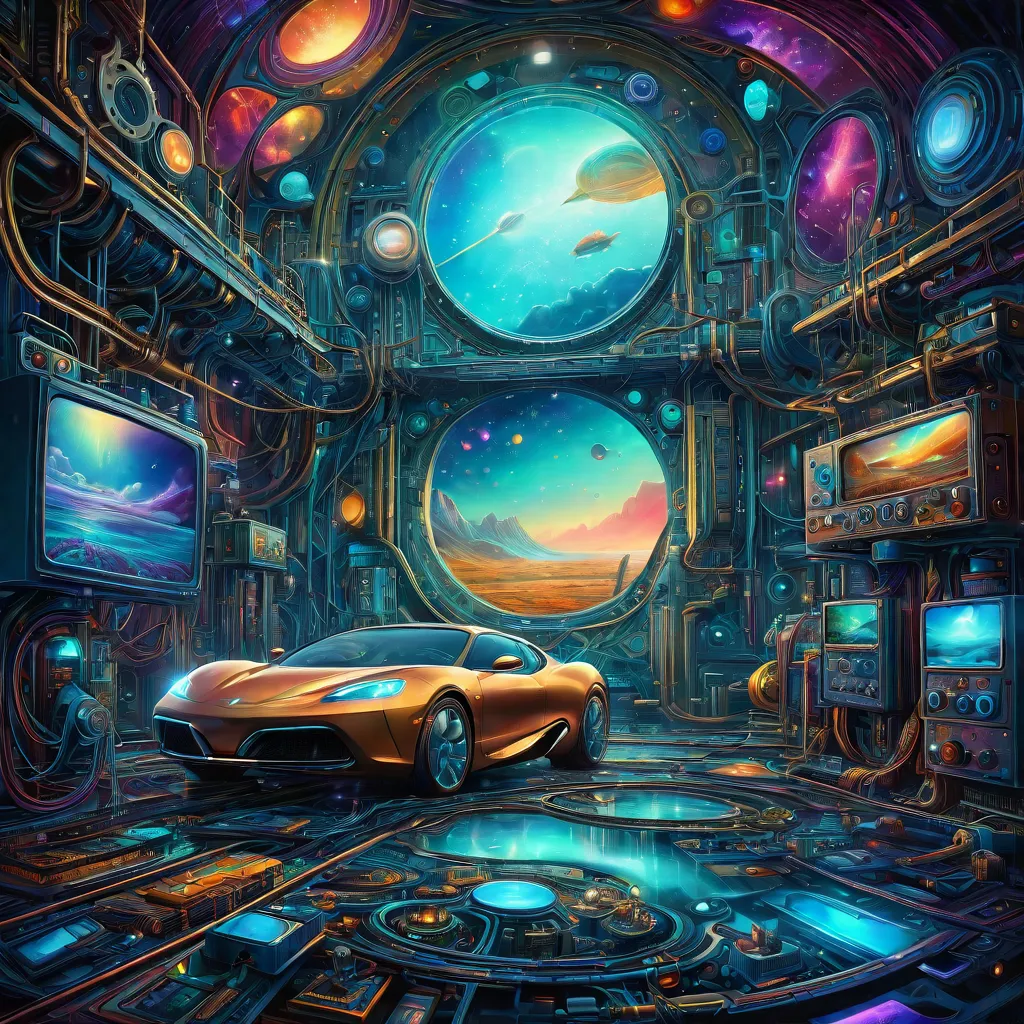
Machine That Won't Work
These dreams feature a complex machine—often a car, computer, or industrial apparatus—sitting idle while the dreamer frantically presses buttons, pulls levers, or flips switches that produce no response. The scene is saturated with the whir of stalled motors, a metallic taste in the mouth, and a rising pulse of frustration.
Psychological Interpretation
You are likely feeling that a project, relationship, or personal goal is stuck despite your best efforts, and the dream mirrors the anxiety of wasted energy. It often appears when deadlines loom, expectations pile up, or you sense a loss of control over a situation you expected to master.
Had this dream?
A car, computer, or machine stays silent as you press buttons, or do levers move without starting anything? Tell us what happened and get a personalized interpretation of your own dream.
Interpret My DreamPsychodynamic / Freudian
In psychodynamic terms the malfunctioning machine in a dream is the manifest content that often disguises a latent conflict about the dreamer’s sense of efficacy and control. The machine, as a symbol of systematic, rational activity, stands for the dreamer’s own internal mechanisms for managing tasks, relationships, or ambitions. When the device refuses to operate, the latent content may reveal a repressed fear that the dreamer’s personal “engine” – the capacity to meet expectations, fulfill responsibilities, or maintain competence – is defective or insufficient. This fear is typically tied to early experiences in which the dreamer felt judged for not performing adequately, leading to an internalized critic that now surfaces as a mechanical breakdown. The emotional pattern that accompanies the dream usually includes frustration, helplessness, and a vague sense of being stuck, which are affective residues of the underlying anxiety about inadequacy. The dreamer may employ defense mechanisms such as intellectualization, by focusing on the technical details of the malfunction rather than the felt disappointment, or displacement, by attributing the failure to an external object rather than to the self. These defenses allow the unconscious conflict to remain hidden during waking life, yet the dream’s vivid image forces a temporary breach of the repression, presenting the problem in a concrete, observable form. People experience this dream when they are confronted with situations that threaten their self-esteem or when they sense that their internal resources are being stretched beyond capacity, such as a demanding project, a strained relationship, or a health challenge. The dream’s message is that the unconscious is urging the individual to acknowledge the feeling of being “broken” and to explore whether the standards they impose on themselves are realistic or internally imposed by earlier authority figures. A practical insight is to pause when the dream arises and ask, “What part of my life feels stuck or ineffective right now?” By naming the specific area and allowing oneself to feel the associated frustration, the dreamer can begin to dismantle the defensive rationalizations and rebuild a more compassionate internal narrative that supports genuine problem-solving rather than symbolic shutdown.
Personal Meaning
The image of a machine that refuses to work often surfaces when the dreamer is wrestling with a sense of personal malfunction. In this view the malfunction is not a literal piece of equipment but a symbolic stand-in for a goal, habit, or role that the sleeper feels should be operating smoothly but is instead jammed or broken. The dream translates the abstract feeling of incompetence or loss of control into a concrete visual, allowing the mind to focus on the frustration that may be circulating beneath daily routines. Psychologically, the dream taps into the brain’s monitoring system for self-efficacy: when expectations of performance clash with perceived inability, the nervous system flags the discrepancy, and the dream dramatizes it as a broken device. The emotional pattern that typically accompanies the dream is a mix of irritation, helplessness, and a quiet anxiety about being judged for not “getting the job done,” which can manifest in waking life as irritability, procrastination, or avoidance of tasks that feel too demanding. People experience this dream most often during periods of transition—starting a new job, taking on a leadership role, or confronting a personal project that feels beyond their current skill set. The subconscious uses the machine metaphor because modern life is saturated with technology, and a malfunctioning gadget instantly conveys the idea of a system that should be reliable but is not. To connect the dream to waking life, the reader can ask themselves: which responsibilities or routines feel like they are “stuck” or “broken” right now? When was the last time I felt that my efforts were not producing the expected result, and what specific obstacles were present? What resources—knowledge, support, tools—are missing that could restore the “machine” to working order? A practical insight that emerges from this reflection is to isolate one element of the perceived malfunction and treat it as a mini-experiment: break the larger task into a single, manageable step, gather the necessary tool or piece of information, and execute that step without the pressure of fixing the whole system at once. By demonstrating that a small part can be repaired, the dreamer rebuilds confidence in their ability to address larger breakdowns, gradually turning the night-time image of a broken machine into a waking narrative of incremental competence.
Contemporary Psychological
When a person dreams of a machine that refuses to work, the brain is often using the malfunctioning device as a stand-in for a sense of personal inefficacy or a situation that feels stuck. Contemporary neuroscience shows that during REM sleep the prefrontal cortex, which supports planning and problem-solving, interacts with the amygdala, the hub of threat detection, to simulate scenarios that challenge one’s sense of control. In this context, a broken machine triggers the same neural circuitry that fires when a real-world task is blocked, allowing the mind to rehearse the emotional response to failure without the risk of actual harm. The dream therefore reflects a consolidation of recent experiences—perhaps a missed deadline, a technical glitch at work, or a lingering feeling that one’s efforts are not producing the expected results—into a symbolic narrative that the brain can process while it reorganizes memory. The emotional pattern that typically accompanies this dream is a blend of frustration, anxiety, and a subtle undercurrent of helplessness. The amygdala’s heightened activity signals a perceived threat to self-esteem, while the hippocampus re-activates episodic memories of past setbacks, reinforcing the feeling that the situation is recurring. This combination can produce a physiological stress response even in sleep, as cortisol levels rise to support the brain’s threat-simulation function. The dream thus serves as an internal alarm, flagging unresolved concerns about competence and the fear that one’s “inner machinery” is not operating smoothly, which can spill over into waking mood and motivation. A practical insight that emerges from this pattern is to treat the malfunctioning machine as a diagnostic cue rather than a vague omen. By identifying a specific waking domain—such as a project that feels stalled or a skill that feels underdeveloped—the dreamer can deliberately engage the prefrontal-amygdala circuit during waking hours, breaking the problem into smaller, manageable steps and practicing self-compassion to reduce the threat signal. Journaling the dream immediately upon waking, followed by a brief plan of concrete actions, leverages the brain’s natural consolidation process, turning the night-time simulation into a catalyst for purposeful change.
Jungian / Archetypal
In Jungian terms the malfunctioning machine is a vivid image of the ego’s apparatus of conscious organization that has lost its capacity to function smoothly. The machine stands for the structures, routines, and rational strategies that a person has built to manage daily life, while its failure signals the emergence of the shadow—those aspects of the self that have been denied, repressed, or left unintegrated. When the dream presents a broken engine, a jammed gear, or a power outage, it is the collective unconscious projecting the archetype of the “Craftsman” or “Technician” whose tools have turned against him, urging the dreamer to acknowledge the parts of the psyche that are no longer serving the conscious agenda. Emotionally the dream often arises in periods of heightened stress, when the individual feels trapped, ineffective, or disconnected from a sense of purpose. The frustration and anxiety that accompany the image of a non-functional machine mirror a deeper inner conflict: the conscious self is demanding efficiency and control, while the unconscious is signaling that something essential—perhaps a creative impulse, an unprocessed feeling, or a neglected relational need—has been sidelined. This dissonance can manifest as irritability, a sense of being “stuck” in a job or relationship, or a pervasive fear that one’s personal “engine” is losing power. A practical insight that emerges from this symbolism is to treat the broken machine not as a sign of personal inadequacy but as an invitation to perform an inner maintenance check. The dreamer can ask which habits, beliefs, or emotional patterns have become rusted or jammed, and then consciously engage with those shadow elements through journaling, therapy, or creative expression. By repairing or reconfiguring the internal “machinery,” the individual moves a step closer to individuation, allowing the ego’s tools to operate in harmony with the deeper currents of the unconscious.
Gestalt / Parts of Self
In a Gestalt reading, the malfunctioning machine appears as a concrete projection of a facet of the dreamer’s personality that has been split off and left to operate in isolation. The machine, with its gears, circuitry, and purpose, stands for a skill, desire, or responsibility that the dreamer once identified with—perhaps a career ambition, a creative project, or a sense of personal competence. When the device refuses to start or stalls, the dream signals that this part of the self is being denied acknowledgment, left to “break down” because it is not being invited into the conscious field. The dreamer is therefore witnessing a disowned capability or drive that has been relegated to the unconscious, and the machine’s failure dramatizes the internal tension created by that exclusion. The emotional texture that accompanies the dream often includes frustration, helplessness, or a vague anxiety about not meeting expectations, whether those expectations are self-imposed or imposed by others. These feelings arise because the split part still exerts influence, manifesting as a sense that something essential is “stuck” or “out of control.” The dream’s repetition across different people suggests a common pattern: when individuals suppress a part of themselves that is associated with productivity, agency, or identity, the psyche creates a symbolic malfunction to draw attention to the imbalance. The machine’s inability to work thus becomes a mirror of the dreamer’s inner feeling of being blocked, and the dream serves as an invitation to locate the source of that blockage within the self rather than attributing it to external circumstances. A practical step that emerges from this interpretation is to treat the malfunctioning machine as a dialogue partner rather than a mere obstacle. By visualizing a conversation with the machine—asking what it needs to run, what is preventing it from turning on, and what it would like to express—the dreamer can begin to reclaim the disowned aspect and negotiate its reintegration. This inner dialogue can be carried out through journaling, guided imagery, or a brief meditation in which the dreamer offers the machine the attention and resources it has been denied. By consciously acknowledging and integrating the projected part, the sense of frustration diminishes, and the dreamer gains a more cohesive sense of agency in waking life.
Stress & Emotional Patterns
Dreams in which a machine—whether a car, a computer, a coffee maker, or a complex piece of industrial equipment—refuses to start or breaks down often surface when the dreamer feels stuck in a situation that should be routine or under their control. The mind translates the frustration of a malfunctioning device into a symbolic representation of personal efficacy: you may be confronting a project at work that isn’t progressing, a relationship that feels “broken,” or a health regimen that isn’t yielding results. The anxiety that fuels the dream is usually tied to a sense of helplessness or a fear of being judged for not delivering as expected. Because machines are built to follow predictable rules, their failure feels like a betrayal of logic, amplifying the emotional load of feeling out of sync with your own expectations and the external pressures to perform efficiently. When this dream recurs, it can be a useful signal that you are carrying more responsibility than you have bandwidth for, and that the stress is accumulating in a way that threatens your wellbeing. A practical first step is to pause and map the “machine” to a concrete area of life—work deadline, family obligation, financial planning, or even self-care routines. Then, break that domain into smaller, testable actions, treating each as a maintenance check rather than a single, all-or-nothing repair. Allow yourself permission to ask for help, delegate, or temporarily step back, recognizing that a malfunction is not a personal flaw but a cue that the system needs recalibration. Complement this with grounding practices such as brief mindfulness breathing or a short walk, which can lower the physiological arousal that fuels the dream’s intensity and restore a sense of agency before the next night’s narrative unfolds.
Related Symbols
Had this dream?
Get a personalized AI interpretation that connects your dream to your specific life circumstances.
Interpret My Dream